Pain Points & Technical Challenges
Production lines commonly require a single-station cycle time of 2.5 seconds or less. In a conventional pneumatic-cylinder and shock-absorber combination, speed and cushioning force affect one another. Commissioning relies on adjusting flow-control valves and mechanical stops. After a changeover, repeatability can vary by ?0.3 mm, forcing the vision system to take corrective images and consuming valuable cycle time.
For long-distance material transport, multiple hydraulic cylinders are synchronized by flow-divider/combiner valves. Manufacturing variation in the valve spools can produce 8%?12% flow deviation and uneven loading. Pallet levelness then exceeds tolerance and precision workpieces may slide and become scratched.
During the rainy season in southern China, moisture in compressed air rises sharply. Corrosion and sticking of solenoid-valve spools can require unplanned line shutdowns for pipe purging at least twice a week.
Yiruiju Customized Technical Solutions
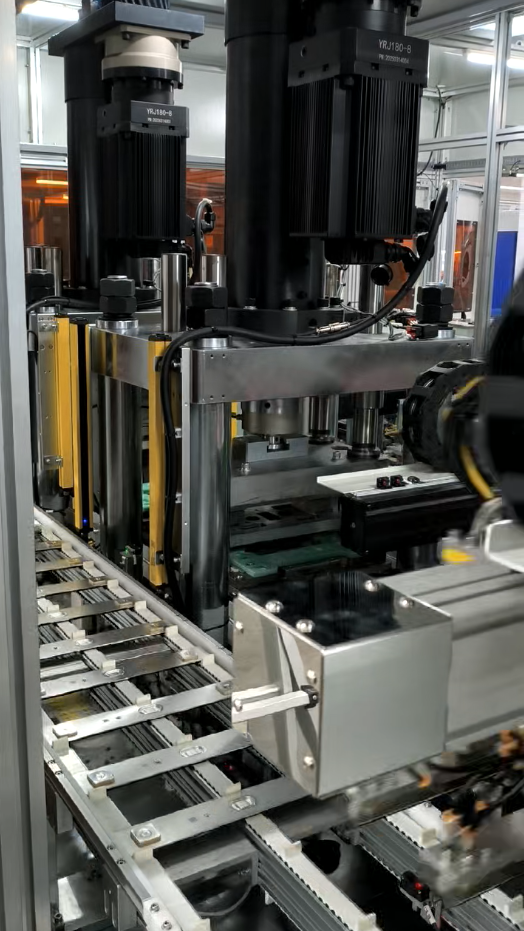
EtherCAT servo electric cylinders operate with a 1 ms synchronization cycle and less than 5 ?s station-to-station jitter, providing absolute synchronization for coordinated multi-axis gantries. An embedded S-curve look-ahead planner begins deceleration 300 ms before the end of travel. End-position impact is 70% lower than with a trapezoidal profile, and ?0.01 mm repeatability is achieved without shock absorbers.
An absolute multi-turn encoder and redundant magnetoresistive limits retain coordinates permanently after power loss. No homing search is required after restart. During changeover, recipe parameters are sent to all cylinders over the bus in one operation, reducing full-line changeover time from 45 minutes to six minutes.
For humid environments, the cylinder uses IP68 protection and a PTFE-coated piston rod, with salt-spray resistance of at least 720 hours. Removing pneumatic tubing eliminates dew-point-related actuator failures and reduces annual failures from an average of 24 to no more than two.